
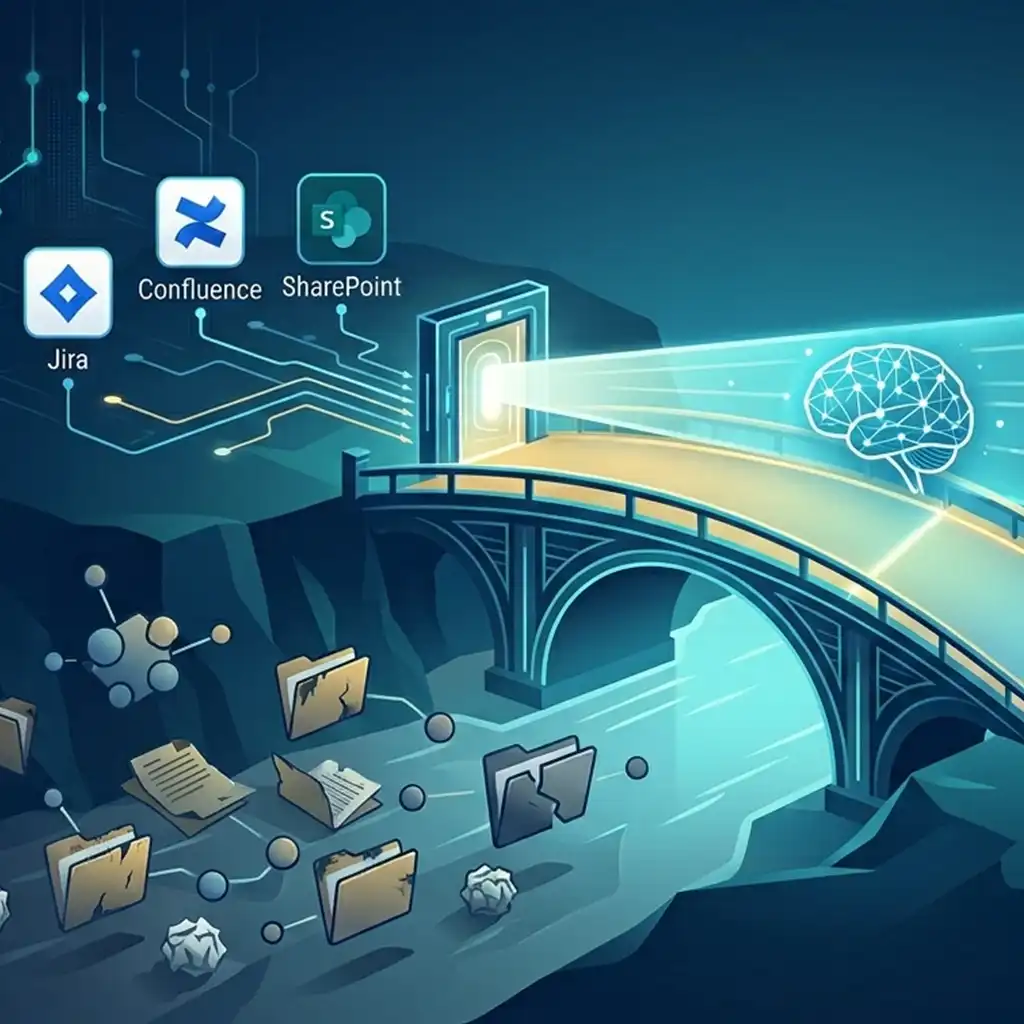
See what's possible.

Industry
/
AI
AI. Engineered for Impact.
IPS engineers AI directly into your product — from edge inference on embedded hardware to LLM-powered knowledge systems built around your operational data. We don't bolt AI on. We architect it in.

No items found.
No items found.
Redefining Intelligence: From Concept to Deployment
While the potential of Artificial Intelligence is limitless, the path to implementation is often complex. At IPS, we cut through the noise by building AI systems that are purpose-built for high-stakes environments. We don't just "add AI" to a product, we architect end-to-end intelligence layers that evolve with your data.
By combining rigorous software engineering with cutting-edge data science, we transform raw computational power into a strategic asset. Whether you are seeking to automate sensory perception through Computer Vision or unlock deep organizational knowledge via LLM-driven protocols, our approach ensures your AI is secure, efficient, and most importantly engineered to solve your most specific operational challenges.


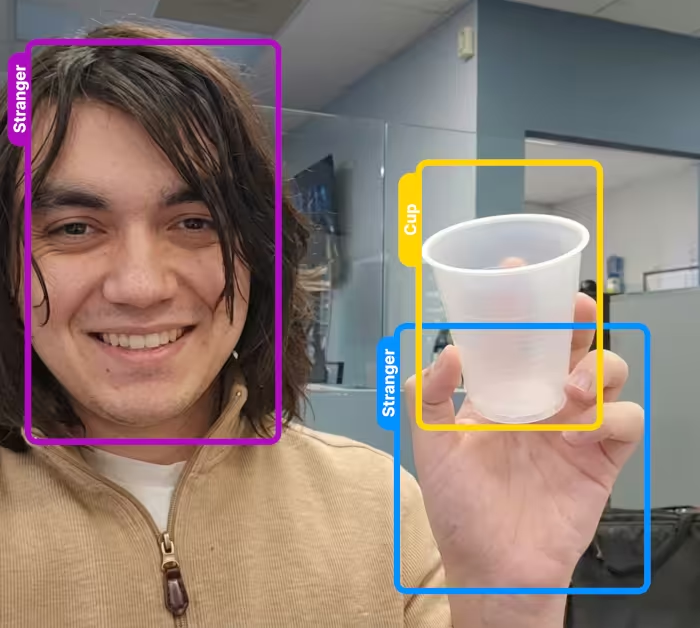
Face and Object Detection
An application that provides the ability to learn the unique characteristics of a person’s face and allow a name association.
• Designed to run as an offline smartphone application.
• Machine Learning generates embeddings for facial recognition training.
• Image processing leveraging pre-trained models for object detection.
• Determine layout of objects in scene (e.g.cup in hand).
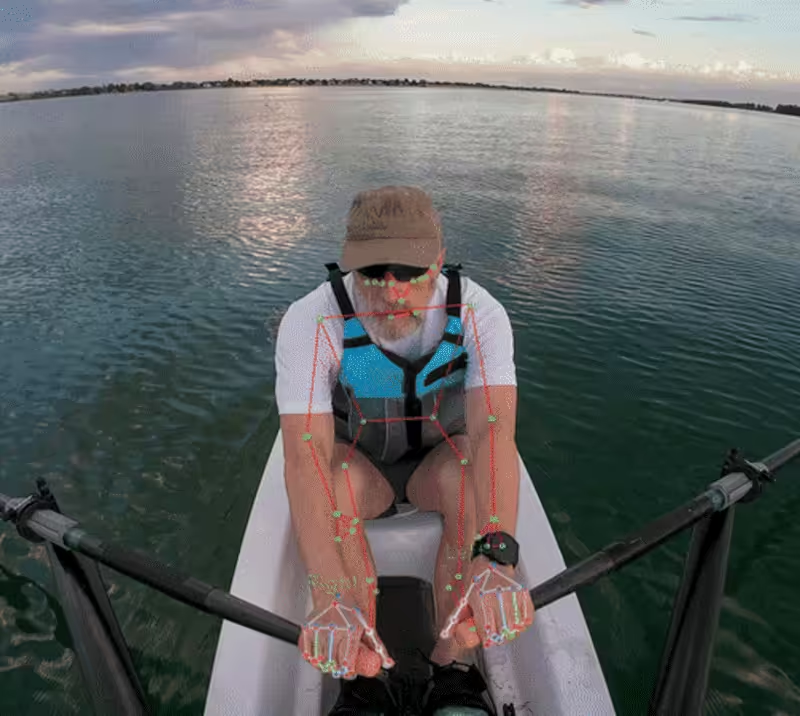
Workout Detection
Exercise feedback and assistant application that can interpret a user’s form and evaluate the effectiveness of their workout in real-time.
• Designed to run as an offline smart phone application.
• Does not rely on cloud or off-site AI processing.
• User’s form interpreted from their position and orientation in 3D space.
• Determine the type of workout being performed based on the motions made.
• Count and grade the quality of repetitions.
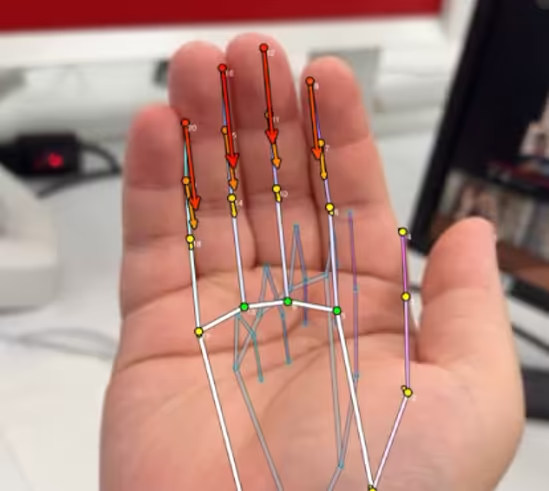
Sign Language
Assistant that can visually inspect a person’s hand orientation and derive the meaning based on American Sign Language definitions.
• Designed to run as an offline smartphone application.
• Landmarking of the hand, including vectors for finger orientation.
• Utilizes a base model and performs training through a smaller data set.
• High degree of accuracy in recognizing the English alphabet.
• Includes gesture recognition for word and phrase recognition.
Solutions in Action
No items found.
Capabilities & Expertise

Edge AI & On-device Processing
Our team specializes in deploying "intelligence at the edge," bringing powerful model inference directly to local hardware and IoT devices. This approach minimizes latency, reduces bandwidth costs, and ensures data privacy by processing sensitive information locally without the need for constant cloud connectivity.

Machine Learning & Predictive Analytics

Computer Vision & Spatial Intelligence

Audio Processing & Speech Intelligence
We develop sophisticated audio pipelines for noise suppression, real-time speech-to-text, and acoustic event detection. Whether it’s building voice-controlled interfaces or analyzing industrial machinery through sound signatures, we bridge the gap between raw audio signals and meaningful digital insights.

LLM Integration & Context Protocols
We go beyond basic chatbots by integrating Large Language Models (LLMs) into your existing workflows using custom context protocols and RAG (Retrieval-Augmented Generation). Our integrations allow for "aware" systems, such as custom NPC sensors or intelligent knowledge bases, that understand your specific data environment.

Generative AI & Synthetic Data
We harness the power of generative models to create high-fidelity synthetic datasets and automated content pipelines. This capability allows businesses to train models in data-sparse environments or create dynamic, personalized user experiences that scale without manual intervention.

AI-Driven Intelligent Sensing & Vision
IPS provides end-to-end Sensor Fusion and Computer Vision (CV) engineering to deliver real-time intelligence across diverse data streams. Our engineers can utilize Machine Learning (ML) to interpret complex signals from a multitude of sensors, including but not limited to optical, induction, and ultrasonic. We specialize in transforming raw sensor data into action at the edge.
Generative AI: RAG & Large Language Models (LLMs)
IPS leverages Generative AI and Large Language Models (LLMs) to build secure, context-aware systems for natural language processing and multimodal communication. We specialize in Retrieval Augmented Generation (RAG), allowing businesses to query private document corpuses with the power of AI while maintaining strict data sovereignty. Our expertise includes architecting hybrid solutions that span from cloud-based services to private, offline environments.
Edge AI & Embedded Intelligence
IPS designs feature Edge AI and embedded intelligence, bringing machine learning directly to hardware devices. This enables fast, reliable decisions without relying on the cloud. Technologies like LiteRT and hardware such as Google Coral TPUs eliminate the need for external connectivity, enabling our devices to perceive and reason in real time. The ESW team optimizes complex ML models for constrained hardware, allowing intelligence in devices with limited power, memory, and processing.